· 8 min read
How to Increase Direct Bookings for US Hotels and Vacation Rentals
To increase direct bookings for a small US hotel or vacation rental business, start with three things: make your property easy to evaluate, let guests check availability and reserve without unnecessary steps, and give previous guests a reason to return. Keep online travel agencies (OTAs) as one source of demand, but measure what you retain from each booking rather than chasing a direct-booking percentage alone.
This guide is for independent hotels, inns, cabin operators and vacation rental managers in the United States. It focuses on improvements a small team can make without building a large marketing department. It does not assume that direct bookings are free, that one commission rate applies to every OTA, or that booking software automatically handles every US tax requirement.
1. Calculate what a direct booking is actually worth
Start with contribution, not the headline room price. Compare the booking value excluding taxes you collect for authorities, then subtract channel-specific costs: OTA commission, payment processing, advertising, discounts and any extra booking-related service cost. Do not count the same cost twice if it is already included in a channel fee.
Hypothetical example: a stay generates $500 before tax. If its OTA commission is 15%, the commission is $75 and the amount remaining is $425 before other costs. A direct booking at the same price with $25 in payment and acquisition costs leaves $475. The difference is $50. But a $60 direct discount reduces that amount to $415, making it less attractive than the OTA booking in this simplified comparison. These are illustrative assumptions, not Revoo pricing or a typical US commission rate.
- Direct booking share = direct reservations divided by all reservations for the same period. Keep the definition consistent.
- Website booking conversion = completed website reservations divided by website visits. Separate inquiries from confirmed bookings.
- Acquisition cost per direct booking = attributable marketing spend divided by bookings attributed to that spend.
- Compare repeat-guest bookings and cancellation rates as well as revenue. A channel that produces many cancellations can look stronger than it is.
2. Make the website answer the questions an OTA listing answers
A traveler choosing a cabin near a national park or an independent hotel for a weekend trip wants concrete answers. Show the actual room or unit, bed configuration, maximum occupancy, parking, location, check-in arrangements and cancellation terms. Explain pet rules, accessibility details and amenities accurately; never use a general promise such as accessible without describing the relevant facilities.
- Use current photos of the exact room or unit guests can reserve, including the bathroom and important shared spaces.
- Describe the location with useful distances or travel times only when you have verified them.
- Keep room names, capacities and policy wording consistent between your own website and other listings.
- Place an availability or booking action where guests can find it without searching through a contact page.
- Test the complete reservation flow on a phone, including date selection, the price summary and the confirmation message.
3. Reduce friction between availability and confirmation
A guest should not need to email for a price that is already available, repeat the same details in multiple forms, or wonder whether a reservation succeeded. Let them select dates, review the correct room or unit and understand the final terms before committing. Request only the information you genuinely need at that stage.
Revoo's direct booking engine for property websites brings availability and reservations onto a property's own website. When evaluating any system, ask for a demonstration of your actual guest journey: how prices display, what happens when a unit becomes unavailable, which payment options are supported and how the guest receives confirmation. Confirm the required currency and payment setup before implementation.
4. Show mandatory fees clearly for US guests
The FTC's Rule on Unfair or Deceptive Fees took effect on May 12, 2025 and covers short-term lodging. When a business advertises a price, the rule generally requires the total price to include mandatory charges and be displayed more prominently than other pricing information. For a cabin or vacation rental, a required cleaning fee cannot simply appear as a surprise at checkout. Government charges, such as taxes, and certain other charges have specific treatment under the rule; consult the official guidance for the details.
Review the first advertised price, room-selection screen and checkout summary together. A transparent checkout does not correct an earlier misleading advertised price. Also check applicable state and local requirements, which may impose additional obligations. Booking software alone is not a legal compliance guarantee.
Read the FTC announcement of the rule on lodging fees and the official rule published in the Federal Register. This section is general information, not legal or tax advice.
5. Give guests a reason to book direct without erasing your margin
A direct-only benefit does not have to be a large discount. Consider flexible cancellation terms, a useful package or a small service you can reliably provide. For a cabin property, that might be a clearly priced extra-night package; for an inn, it might be a breakfast offer. Do not promise early check-in or a late checkout if your turnover schedule cannot support it.
Review your OTA agreements before introducing channel-specific rates or benefits. Do not assume a ruling or rate-parity practice in Europe applies to your US contracts. Keep inclusions, cancellation terms and required fees clear so guests can compare offers fairly.
6. Bring back previous guests responsibly
Repeat business can reduce the need to acquire every reservation from scratch. With the appropriate permissions, send useful messages about a relevant return stay, a genuinely available seasonal package or an event near the property. Segment by what guests actually booked rather than sending an identical offer to everyone.
For US commercial email, review CAN-SPAM requirements: accurate sender information and subject lines, required identification and address information, and a functioning opt-out process. Respect unsubscribes and any additional privacy or platform obligations. An OTA booking is not blanket permission to reuse guest contact details for marketing; review the channel's terms and how those details were obtained.
The FTC's CAN-SPAM compliance guide for businesses explains the federal requirements. Use your own guest relationships and lawful contact practices, not purchased lists presented as a shortcut to organic demand.
7. Build search visibility around the stay, not just the software
Your property's website needs to answer local booking questions. Create useful accommodation pages for real room types and genuine travel needs: cabins near a particular destination, an inn with verified parking arrangements, or lodging for a specific local event. Avoid dozens of near-identical location pages for places where you do not operate.
- Keep the property name, address and contact details consistent wherever they appear.
- If the property is eligible, maintain an accurate Google Business Profile with the correct booking website.
- Ask real guests for honest reviews without inventing testimonials or rewarding only positive feedback.
- Seek relevant links from local tourism organizations, event partners and businesses with a genuine relationship to the property.
- Link local guides to the relevant room or availability page so readers have a clear next step.
8. Keep direct bookings connected to daily operations
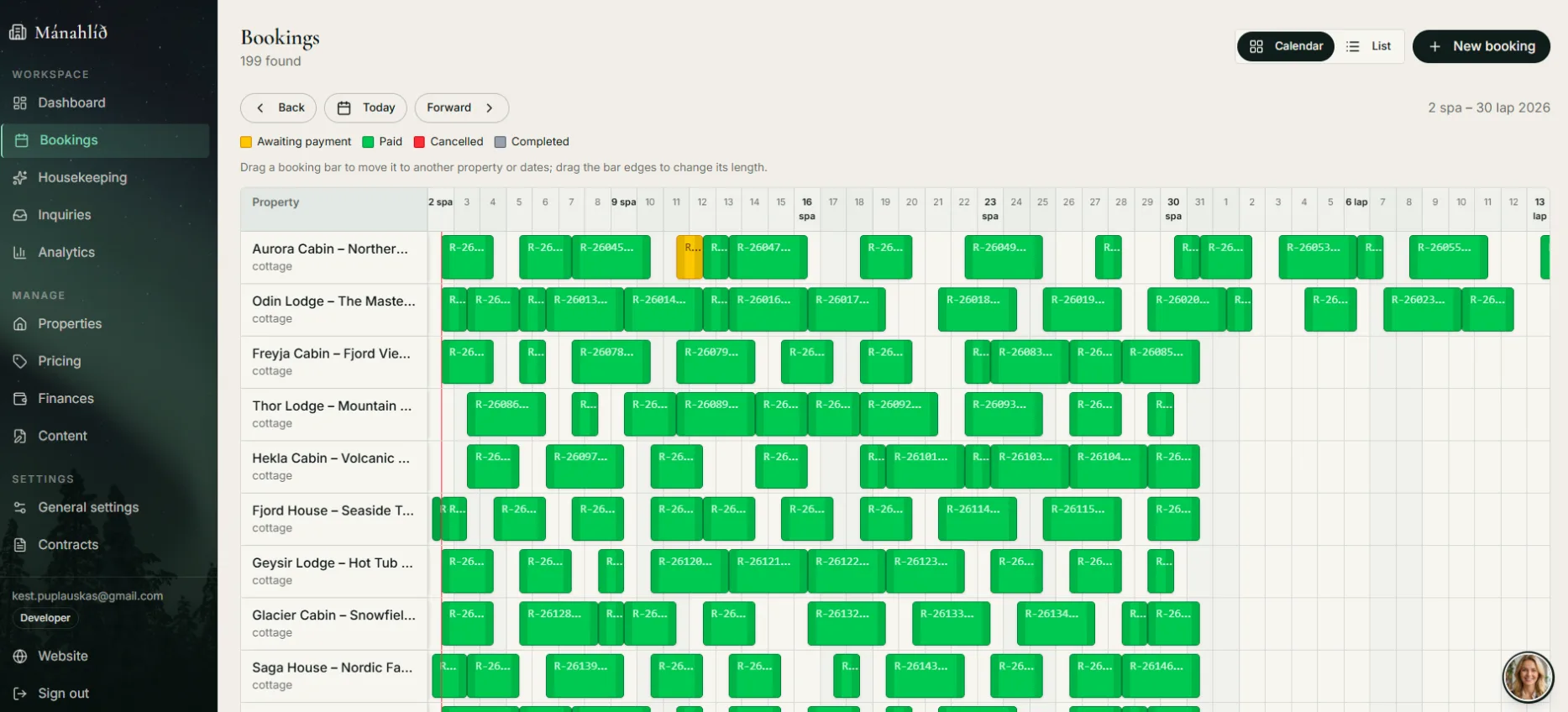
More direct reservations are not a win if availability is wrong or staff miss changes. Use one operational record for arrivals, departures and room status. Revoo's property management system for small accommodation businesses provides a central calendar for the team's daily work. Before relying on channel synchronization, verify which connections are supported and their update timing; calendar-feed imports should not be assumed to provide instant, full two-way synchronization.
Set rates and restrictions deliberately rather than offering the same discount every day. The seasonal pricing and revenue management tools can support the rate rules you configure. Ask how minimum stays, long-stay discounts and peak-date rates work for your inventory. A pricing tool does not guarantee higher revenue, and the best rule depends on your demand and operating costs.
A practical 30-day direct-booking plan
- Week 1: establish a baseline. Record direct booking share, website reservations, cancellations and channel costs. Review your OTA contracts and document the exact mandatory fees for each stay.
- Week 2: repair the guest journey. Update actual room photos and policies, test availability on a phone, remove unnecessary fields and verify the total-price display through checkout.
- Week 3: publish one useful local page and one viable direct offer. Link both to the correct booking page. If you have an appropriately collected guest list, prepare a relevant return-stay message with a working unsubscribe process.
- Week 4: compare results with the baseline. Look at completed bookings and contribution, not just traffic. Identify where guests leave the booking flow, then fix the largest friction point before increasing marketing spend.
What to check before choosing booking software
Bring your room inventory, existing website, current channels and fee structure to a demonstration. Ask the provider to show a reservation with your dates, rate rules and mandatory charges, explain payment and cancellation handling, and demonstrate how staff see the booking. For a US property, confirm currency support, required tax configuration and the exact scope of channel connections in writing. Revoo can be evaluated against that checklist; capabilities should be confirmed for your property's setup rather than assumed from a generic feature list.
The aim is not to leave OTAs overnight. It is to make your own website a credible booking option, build a repeat-guest relationship and understand the economics of each channel. Start with a guest journey that works, then grow the traffic you can convert.
This article is general information, not tax or legal advice. Check specifics with your accountant or your national tax authority.
Wondering whether Revoo fits your property?
One 15-minute conversation, and an honest answer either way.